
NEWS
At the 2026 State of the Union, Sen. Markwayne Mullin Tries to Snatch Rep. Al Green’s “Black People Aren’t Apes” Sign Referencing Donald Trump’s Truth Social AI Post Depicting the Obamas as Apes — Green Files Criminal Assault Charges, Says Mullin “Doesn’t Like the Truth Seeping Through,” and Claims His Explanation Shows He’s Desperate to Please Trump

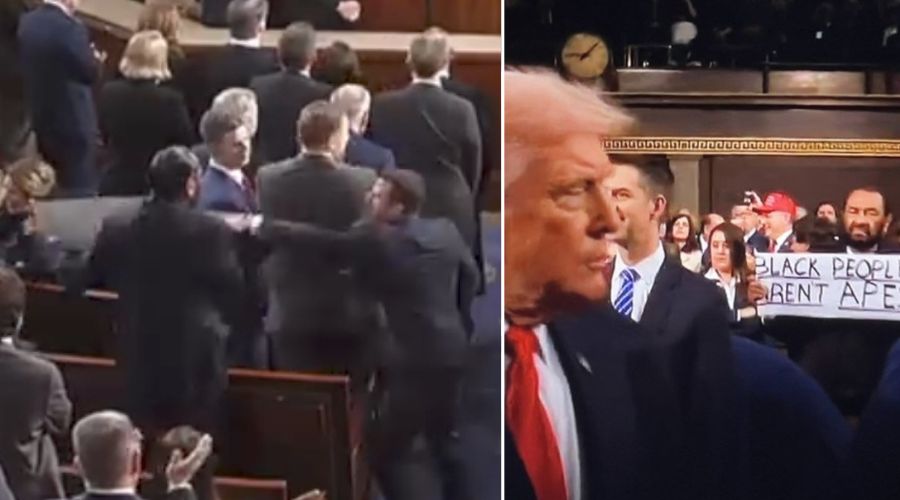
Tensions exploded on the House floor during the 2026 State of the Union in a moment that quickly overshadowed the President’s speech and sent political shockwaves far beyond the Capitol walls.
What began as a silent protest turned into a confrontation.
During the nationally televised address, Rep. Al Green held up a bold black-and-white sign that read: “Black People Aren’t Apes.” The message, stark and unmissable, was not random. According to Green, it was a direct response to a recent Truth Social post from former President Donald Trump that allegedly featured an AI-generated depiction portraying former President Barack Obama and former First Lady Michelle Obama as apes.
Within seconds of the sign being raised, chaos followed.
Sen. Markwayne Mullin reportedly approached Green in what witnesses describe as an attempt to grab or remove the sign. Cameras caught the tense exchange, though the exact physical contact remains under scrutiny. What is clear is that the confrontation disrupted the chamber and triggered immediate outrage on both sides of the aisle.
Green did not back down.
Shortly after the incident, the Texas congressman announced he would be filing criminal assault charges against Mullin, stating that the senator’s actions crossed a line from disagreement into physical intimidation.
“Senator Mullin doesn’t like the truth seeping through,” Green said in remarks following the address. “If the message offends him, he should ask himself why.”
The phrase — “the truth seeping through” — has since circulated widely online, becoming a rallying cry for supporters who argue that Green’s protest highlighted a deeper issue about racial rhetoric in modern political discourse.
The origin of the controversy traces back to the alleged AI-generated image posted on Truth Social. Critics say the depiction of the Obamas as apes evokes a long and painful history of racist imagery used to dehumanize Black Americans. Supporters of Trump have countered that the image was either satire, misinterpreted, or amplified unfairly by political opponents.
The State of the Union confrontation transformed that online debate into a physical, televised clash inside Congress.
Mullin later addressed the incident, saying he found the sign offensive and inappropriate for the solemnity of the event. He argued that the State of the Union should focus on national unity rather than what he described as “provocative stunts.”
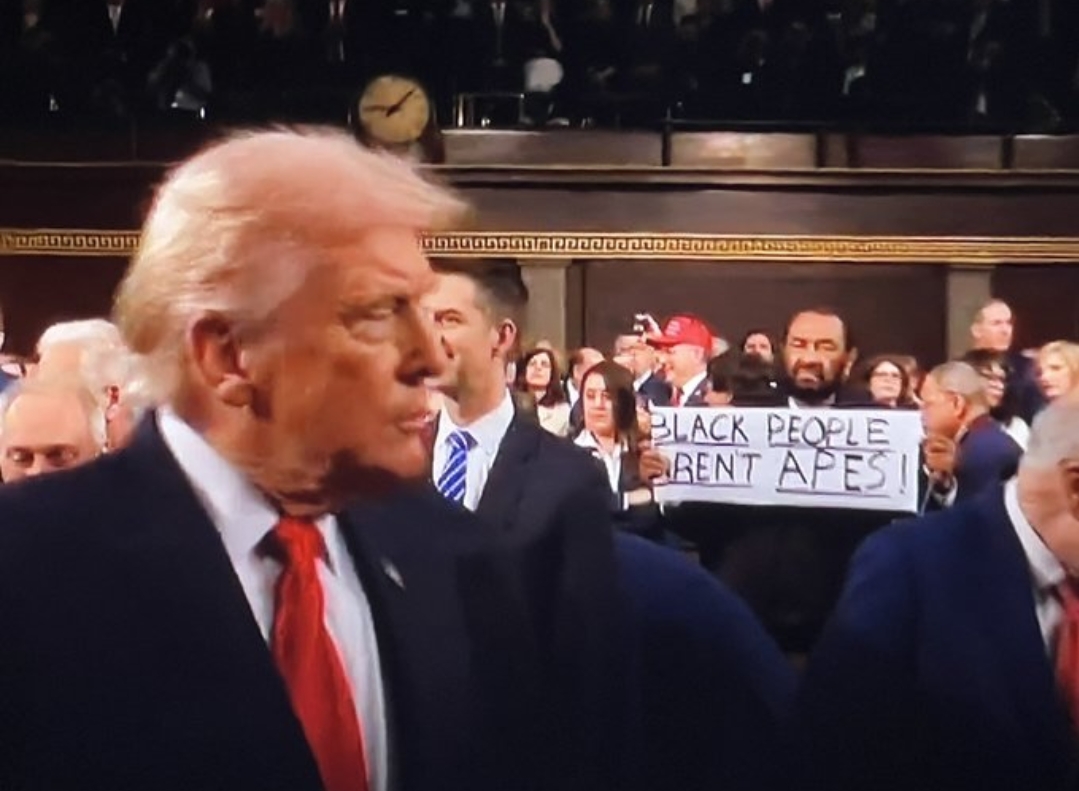
But Green pushed back forcefully, suggesting that Mullin’s reaction revealed more than discomfort with decorum.
According to Green, Mullin’s explanation for trying to remove the sign demonstrates an effort to defend Trump and align himself more closely with the former president’s base. “When someone reacts that strongly to a message condemning racism,” Green stated, “it says more about them than it does about the sign.”
Political analysts note that Mullin, a Republican from Oklahoma, has frequently aligned himself with Trump’s political messaging. Some observers believe the confrontation may play well with conservative voters who view Green’s protest as disruptive. Others argue it risks inflaming racial tensions at an already polarized moment in American politics.
The incident has reignited debate about protest inside congressional chambers. Historically, members have used visual statements and symbolic gestures during high-profile speeches to signal dissent. However, physical altercations — or alleged attempts to seize materials from another lawmaker — are rare and potentially serious.
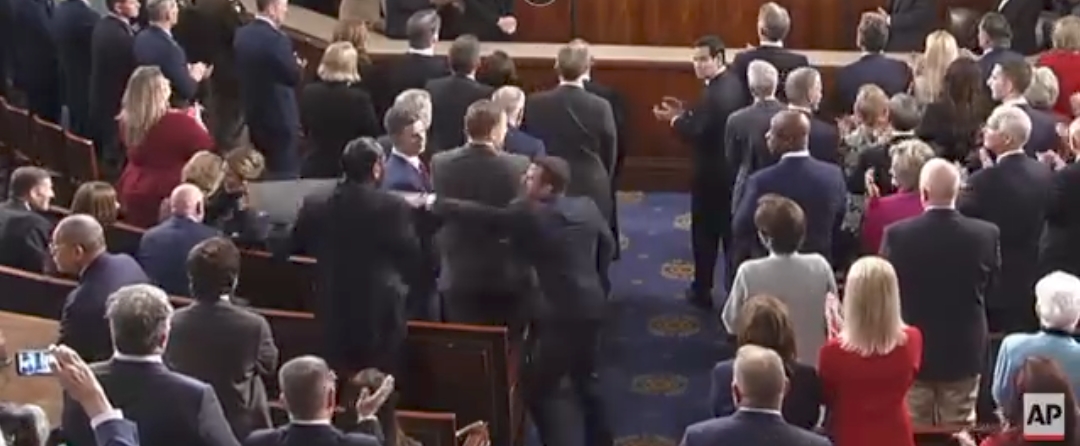
Legal experts caution that filing criminal assault charges between sitting members of Congress is highly unusual and would raise complex constitutional questions. The matter could involve Capitol Police review, ethics investigations, or even internal disciplinary proceedings.
Meanwhile, the broader conversation has shifted to the implications of AI-generated content in politics. As artificial intelligence tools become more accessible, doctored or satirical images can spread rapidly — sometimes blurring the line between parody and harmful stereotype. The alleged depiction of the Obamas has intensified calls for clearer standards and accountability in digital political messaging.
Outside the Capitol, reactions have been fierce and deeply divided.
Civil rights advocates have defended Green’s message, emphasizing the historical weight of comparing Black individuals to apes. They argue that silence in the face of such imagery normalizes dehumanization. Conservative commentators, on the other hand, accuse Green of escalating tensions during a nationally unifying event and politicizing race for attention.
What remains undeniable is that the confrontation has amplified an already volatile political climate.
Instead of headlines focusing solely on policy proposals or economic plans from the State of the Union, the spotlight has shifted to a sign, a struggle over that sign, and the accusations that followed.
For Green, the issue is about confronting what he views as dangerous rhetoric.
For Mullin, it appears to be about preserving decorum and pushing back against what he considers inflammatory messaging.
And for the American public, the moment has become yet another flashpoint in a political era defined by spectacle, symbolism, and sharp divisions.
Whether the criminal assault complaint proceeds or fades into political theater, the image of a sign reading “Black People Aren’t Apes” being contested on the floor of Congress will likely linger.
In a chamber meant to represent the nation’s highest deliberative body, the clash underscored how debates over race, technology, loyalty, and political allegiance are no longer confined to online platforms.
They are unfolding, in real time, at the very center of American power.
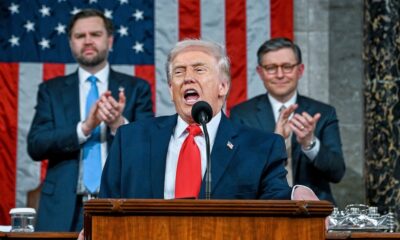

BREAKING: Donald Trump Addresses the Nation After Being Impeached and Removed from Power

BREAKING: Iran attacks US 5th fleet in Bahrain after Trump launched ‘massive’ US and Israeli attack on Iran

Donald Trump is issuing an executive order declaring a “national emergency” to give himself unprecedented powers over elections. The order could allow him to interfere with voting ahead of the midterm elections.

BREAKING: Donald Trump is reportedly “raving mad” that Democrats will be broadcasting a live feed of his SOTU speech tonight from a thermal camera that shows if he poops himself, and is furious that this “Trump Dump Detector” could get more viewers than the regular broadcast.

BREAKING: The Republicans deposing Bill and Hillary Clinton over the next two days are reportedly extremely nervous because Donald Trump—very out of character—hasn’t said a word about it, and they’re afraid the Clintons’ answers might lead to the end of Trump’s presidency.

At the 2026 State of the Union, Sen. Markwayne Mullin Tries to Snatch Rep. Al Green’s “Black People Aren’t Apes” Sign Referencing Donald Trump’s Truth Social AI Post Depicting the Obamas as Apes — Green Files Criminal Assault Charges, Says Mullin “Doesn’t Like the Truth Seeping Through,” and Claims His Explanation Shows He’s Desperate to Please Trump

JUST IN: Minnesota Gov. Tim Walz calls for the U.S. to pass a law requiring that when Congress votes to go to war, an immediate family member of each member of Congress must immediately be enlisted. See Trump’s Enraged 6-Words Reaction

Appointed AG Jack Smith had 86 witnesses ready to covict Donald Trump for attempting a goddamn coup and all of them were Republicans. His report was then blocked by Trump appointed Judge Aileen Cannon.

BREAKING: Taylor Swift and Travis Kelce’s Secret Vacation in Mexico Turns Tragic in Puerto Vallarta as Mexican Cartel Sets Fires, Pulls People from Their Cars, and Burns Vehicles After a Cartel Leader Was Killed — With Heavy Hearts, Sources Confirm the Couple Has Been…

JUST IN: Greenland PM Jens-Frederik Nielsen says: “President Trump’s idea to send a US hospital ship here to Greenland has been duly noted. But we have a public health system where care is free for citizens.”

JUST IN: Denmark just officially rejected President Trump’s sudden deployment of a “great hospital boat” to Greenland, bluntly declaring the territory does not need foreign healthcare
