
NEWS
BREAKING: Trump has completely lost it tonight, visibly furious as he orders journalists removed from the White House, causing an uproar, but one journalist accidentally leaves his camera and microphone on, capturing Trump’s shocking words that could leave Americans furious

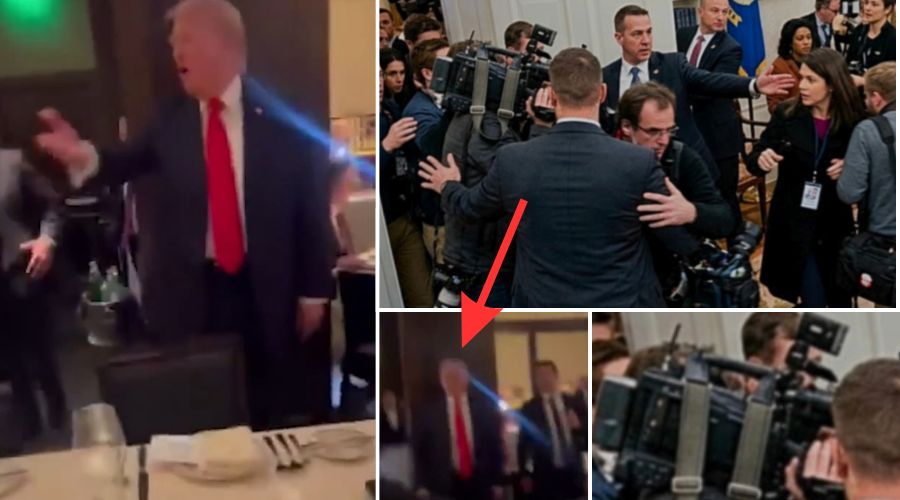
Donald Trump has found himself at the centre of another extraordinary White House controversy after a tense confrontation with journalists reportedly left the room in complete confusion.
The president appeared visibly furious as journalists were ordered to leave, creating an uncomfortable atmosphere that quickly attracted attention.
What initially looked like another heated exchange between Trump and members of the press soon became something much more interesting.
One journalist reportedly left his camera and microphone running, creating the possibility of capturing moments that might otherwise have remained outside public view.
The situation has raised questions about what happened inside the White House, why the journalists were removed and what Trump said afterwards.
Trump has never been a president who quietly accepts difficult questions from reporters. His relationship with the press has repeatedly produced dramatic moments.

Throughout his political career, he has criticised journalists, challenged their reporting and accused major news organisations of treating him unfairly.
His exchanges with reporters have frequently become headline making moments, particularly when questions touch on sensitive political issues.
For journalists covering the White House, questioning the president is an important part of their responsibility.
They are expected to seek answers about government decisions, public spending, international relations and issues affecting ordinary Americans.

However, Trump’s approach to uncomfortable questions has often created tension between his administration and the press.
That relationship makes any confrontation involving the removal of journalists particularly significant.
The latest reported incident has attracted attention because of the suggestion that Trump’s anger was visible before journalists were ordered out.
The atmosphere inside the room was reportedly tense, with the situation developing into an uncomfortable moment for those present.
But the most intriguing part of the story concerns the journalist whose recording equipment allegedly remained switched on.
A camera and microphone can capture considerably more than the words spoken directly during an official briefing.
They can also pick up conversations, reactions and unexpected remarks that happen when people believe recording has stopped.
That possibility has made the reported recording particularly interesting, especially if Trump’s comments went beyond what was publicly discussed.
What exactly did the president say, and was he aware that his words might still be recorded?
Those questions are likely to attract even greater attention if the footage becomes publicly available.
Trump’s relationship with journalists has been complicated by his repeated criticism of coverage that he considers unfair or misleading.
He has frequently challenged reporters during public appearances, sometimes turning routine questions into lengthy disagreements.
For his supporters, these confrontations can demonstrate a president unwilling to accept what he considers hostile questioning.
For his critics, however, they raise concerns about transparency and the treatment of journalists performing their professional duties.
The latest controversy could therefore become another uncomfortable moment in an already complicated relationship.
The White House is one of the most important political workplaces in the world, and journalists play a significant role in informing the public about presidential decisions.
Removing reporters from an event can therefore attract questions about access, accountability and the administration’s willingness to face difficult scrutiny.
The circumstances surrounding the incident are especially important because the public deserves to know what happened before and after the journalists were removed.
There is also the question of whether the recording contains something more revealing than the confrontation itself.
Sometimes, the most interesting moments happen after the cameras are supposedly switched off.
A private remark, an unexpected reaction or a frustrated comment can quickly become the centre of a much larger political controversy.
That is why the suggestion that a journalist accidentally left his microphone running has become such an important detail.
If the recording captures Trump’s actual words, it could provide additional context about his reaction and what was happening behind the scenes.
However, the full recording and its context would be necessary before drawing conclusions about what the president intended to communicate.
For Trump, another confrontation with journalists is unlikely to surprise anyone familiar with his political style.
Nevertheless, the possibility of an unexpected recording adds another dimension to the situation.
Americans are particularly interested in how their president responds when challenged, especially when questions concern decisions that could affect their lives.
The incident could therefore generate further debate about the relationship between the administration and the media.
For now, attention remains focused on the confrontation, the removal of journalists and the possibility that an unexpected recording captured something significant.
What makes the situation especially intriguing is that the most revealing moment may not have happened while the journalists were asking their questions.
It may have happened after they were removed, when Trump believed the cameras and microphones were no longer recording.
If the footage confirms the reported account, the president’s words could become another major talking point in Washington.
And with the White House already facing intense political scrutiny, even a brief unexpected recording could create questions that Trump and his administration would have to address.

Millie Bobby Brown, 22, spotted on a steamy hot date with mysterious man without husband Jake Bongiovi, 24, but one detail about her appearance raises bigger questions

BREAKING: Trump has completely lost it tonight, visibly furious as he orders journalists removed from the White House, causing an uproar, but one journalist accidentally leaves his camera and microphone on, capturing Trump’s shocking words that could leave Americans furious

Amanda Bynes, 40, and her boyfriend Zachary Kahn, 40, spotted together as a surprise baby bump raises questions, while she shows off her Ozempic weight loss and looks slimmer than ever.

Heidi Klum is 53 years old, and she’s hotter than other celebrities at 25. She didn’t even try to hide the assets in this clip, and fans can’t stop looking.

Brittany Mahomes spotted for the first time after reportedly getting breast implants, with fans saying she’s following Kim Kardashian’s lead after the Chiefs’ thrilling 35-12 win against the Jets

BREAKING: Donald Trump has lost his mind as his press conference descends into chaos while he attacks CNN news anchor Kaitlan Collins. After a short minute break, his microphone is accidentally left on, shockingly capturing this and causing massive reactions calling for why Trump is still President

BREAKING NEWS: Donald Trump nearly passes out after introducing Dana White in the White House press briefing room, as cameras accidentally keep recording and capture something a US president should never do, raising questions about his immediate resignation

BREAKING NEWS: Russell Brand to Be Released on Bail Instead of Facing 10 Years in Prison After New Evidence Emerges…

Taylor Swift, Travis Kelce, Patrick Mahomes, and Brittany Mahomes Turn Heads With a Surprise Appearance at the 2026 LACMA Art+Film Gala, Raising Questions About Whether the Chiefs Stars Will Miss the Upcoming Chiefs vs. Jets Game

Meghan Markle, 45, is looking stunning in New Look, raising big questions as she was recently spotted enjoying an intimate quality time with a mysterious man that is not her husband Prince Harry

Jeremy Allen (Wolverine), 35, and Ayo Edebiri, 31, spotted in Los Angeles sharing an intimate moment
